How Porn Affects Your Brain
The Neuroscience Explained
Your brain on porn isn't just a catchy phrase — it's measurable, documented neuroscience. Here's exactly what happens inside your head, why it matters, and how to reverse the damage.
You've probably heard that porn is "bad for your brain." But what does that actually mean? Is it real neuroscience — or just moral panic dressed up in lab coats?
Here's the thing: it's real science. Over the past decade, brain imaging studies have revealed that habitual porn use changes your brain in measurable, structural ways — affecting everything from your dopamine system to the size of your prefrontal cortex.
This isn't opinion. It's MRI data.
📝 TL;DR
Porn hijacks your brain's dopamine reward system, builds tolerance (needing more extreme content), shrinks gray matter in your prefrontal cortex, and weakens your ability to feel pleasure from normal activities. The good news? Your brain is neuroplastic — it can heal. The first step is cutting off the stimulus with a tool like BlockerPlus, then giving your brain time to rewire.
In this article, we'll walk through exactly how porn affects your brain — step by step, system by system. No jargon walls. Just clear explanations of the neuroscience, why it matters for your daily life, and what you can actually do about it.
Let's start with the chemical that makes the whole thing tick.
🧪 The Dopamine Hijack: Why Porn Feels So Rewarding
Dopamine is your brain's "wanting" chemical. It doesn't just make you feel good — it makes you want things. It's the chemical that drives motivation, focus, and goal-directed behavior.
When you eat a great meal, dopamine rises about 50% above baseline. Sex with a partner? About 100%. Cocaine? Around 350%.
Internet porn? It creates a dopamine response that rivals drugs — not because of a single image, but because of something called the "Coolidge Effect."
Here's the thing: your brain is wired to seek novelty. In evolutionary terms, a new potential mate triggered a dopamine surge to motivate pursuit. Internet porn exploits this perfectly — every click delivers a "new mate," and your brain fires dopamine every single time.
One study from 2014 at Cambridge University's Department of Psychiatry found that compulsive porn users showed the same pattern of brain activity when viewing pornographic cues as drug addicts showed when viewing drug cues. The ventral striatum — your brain's reward center — lit up identically.
350%+
Dopamine spike from novel sexual stimuli — comparable to stimulant drugs
But it gets worse: your brain isn't designed to handle unlimited novelty. In natural environments, new sexual stimuli are rare. On the internet, they're infinite.
This creates a problem your ancestors never faced: a dopamine faucet that never turns off.
📉 Tolerance: Why You Need More and More
Your brain has a built-in defense mechanism against overstimulation. When dopamine floods your reward circuits repeatedly, your brain responds by reducing the number of dopamine receptors — a process called downregulation.
Think about it: if someone shouts at you all day, you eventually stop hearing them. Your brain does the same thing with dopamine.
The result? You need more stimulation to feel the same level of reward. This is tolerance — the same mechanism behind every addictive substance and behavior.
In practical terms, tolerance shows up as:
- →Escalation to more extreme content — what once felt exciting becomes boring
- →Longer sessions — needing more time to achieve the same effect
- →Difficulty feeling pleasure from normal activities — food, exercise, socializing feel flat
- →Needing porn to feel "normal" — rather than feeling good, it just prevents feeling bad
A 2014 study published in JAMA Psychiatry by researchers at the Max Planck Institute found that men who reported higher porn consumption had significantly fewer dopamine receptors in the striatum — the same pattern seen in substance addiction.
💡 Pro Tip
If you've noticed that everyday activities feel less enjoyable than they used to, that's not depression — it might be dopamine downregulation from porn use. The fix starts with removing the superstimulus. BlockerPlus blocks over 1 million adult sites across all browsers and apps — so your brain gets the break it needs.
🧠 Sensitization: The Autopilot Trigger
While tolerance makes everything else feel duller, a parallel process makes porn-related cues feel more powerful. This is called sensitization.
Here's what most people don't realize: your brain creates a superhighway between triggers and the reward response. Over time, even subtle cues — a certain time of day, being alone, a specific emotional state — can trigger intense cravings that feel almost automatic.
This is why people describe feeling "on autopilot" when they relapse. The cue-response pathway has become so well-worn that it bypasses conscious decision-making entirely.
Neuroscientists call these "incentive salience" pathways. In plain English: your brain assigns extreme importance to anything associated with the reward, making those cues impossible to ignore.
Research by Voon et al. (2014) demonstrated that compulsive porn users showed enhanced attentional bias toward sexual cues — their brains literally prioritized porn-related stimuli over everything else in their visual field.
This creates a cruel paradox:
- ✕Tolerance means porn gives less pleasure
- ✕Sensitization means you crave it more
Less enjoyment + more craving = the textbook definition of addiction.
🛡️ Break the autopilot cycle
BlockerPlus puts a wall between triggers and access — so your brain has time to choose differently.
Try BlockerPlus Free →🔬 Structural Brain Changes: Porn Literally Shrinks Gray Matter
This is where the science gets uncomfortable.
The Max Planck Institute study mentioned earlier didn't just measure dopamine receptors. They also scanned the brain structures of regular porn users and compared them to non-users.
The findings were striking: higher pornography consumption was directly correlated with reduced gray matter volume in the right caudate of the striatum.
But it gets worse: the same study found reduced functional connectivity between the striatum and the prefrontal cortex — the "communication line" between your reward system and your decision-making center.
In practical terms, this means:
- →Weaker impulse control — your brain's "brake pedal" is literally smaller
- →Poorer decision-making — especially when emotions or urges are involved
- →Reduced willpower — not because you're weak, but because the hardware is compromised
Let me explain: your prefrontal cortex is the part of your brain responsible for long-term planning, self-control, and weighing consequences. It's what separates impulsive reaction from thoughtful response.
When porn weakens this region, you're essentially fighting addiction with a compromised command center. This is why "just use willpower" fails — the very system you'd use to exercise willpower has been degraded by the behavior you're trying to stop.
⚠️ Warning
These structural changes don't happen overnight — they develop gradually with repeated use. But the good news is they're reversible. Neuroplasticity works both ways. Stop the stimulus, and your brain starts rebuilding.
💔 How Porn Rewires Your Arousal Template
Beyond dopamine and gray matter, there's another way porn affects your brain that has devastating real-world consequences: it rewires what turns you on.
Your brain's sexual arousal system is remarkably plastic — it adapts to whatever stimuli it's repeatedly exposed to. This is called "conditioning," and it works the same way Pavlov's dogs learned to salivate at a bell.
Here's what happens with habitual porn use:
- ✕You become aroused by pixels, not people — your brain maps arousal to screens, specific angles, and scenarios that don't exist in real life
- ✕Real partners feel underwhelming — because they can't compete with curated, edited, infinite novelty
- ✕Porn-Induced Erectile Dysfunction (PIED) — an increasingly common condition in young men
- ✕Emotional disconnection during sex — needing to fantasize about porn to maintain arousal
A landmark study by Park et al. (2016) found that young men who consumed internet porn regularly were significantly more likely to report erectile dysfunction and delayed ejaculation compared to those who didn't — despite having no underlying medical conditions.
The good news? This is reversible. Men who abstain from porn for 90+ days consistently report dramatic improvements in real-world arousal, sexual performance, and emotional connection with partners.
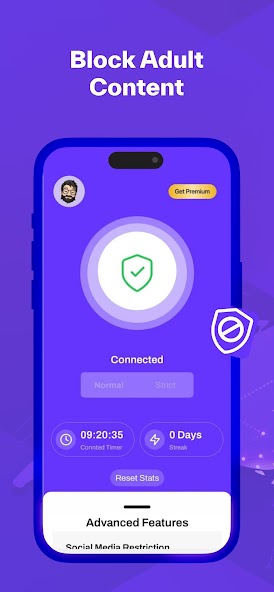
 BlockerPlus — block the stimulus, let your brain heal
😶🌫️ The Stress System: Porn, Cortisol, and Anxiety
Here's what most people don't realize: porn doesn't just mess with your pleasure system. It also disrupts your stress system.
When your dopamine system is chronically overstimulated, your brain compensates by activating stress hormones — particularly cortisol and corticotropin-releasing factor (CRF). This creates a persistent low-level state of anxiety and dysphoria when you're not using.
This is why many habitual porn users report:
- →Increased anxiety — especially social anxiety
- →Brain fog and difficulty concentrating
- →Low motivation and apathy
- →Irritability and mood swings
- →Depression and emotional numbness
Bottom line: porn doesn't just steal your pleasure — it adds stress. The combination of a dulled reward system and an overactive stress system creates a mental state that's the opposite of wellbeing.
And because porn temporarily relieves this stress (by spiking dopamine), it creates a self-reinforcing cycle: feel bad → use porn → feel briefly better → feel worse → use more porn.
🔄 Recognize this cycle? You're not crazy — your brain chemistry is working against you. Keep reading to learn how to break free.
🪞 Mirror Neurons and Empathy Erosion
There's an aspect of how porn affects your brain that gets almost no attention: its impact on empathy.
Your brain contains mirror neurons — cells that fire both when you perform an action and when you observe someone else performing it. They're the neural basis of empathy, allowing you to "feel" what others feel.
Research suggests that repeated exposure to pornography may blunt the mirror neuron response, particularly in the context of sexual and emotional interactions. Over time, this can contribute to:
- →Viewing partners as objects rather than people
- →Difficulty with emotional intimacy
- →Reduced capacity for compassion in relationships
- →Desensitization to the emotions of others
Think about it: when your brain is repeatedly exposed to sexual content stripped of emotional context, it learns to separate physical arousal from emotional connection. This neural separation is incredibly hard to undo — but not impossible.
🧬 Neuroplasticity: Your Brain Can Heal
If everything you've read so far sounds terrifying, here's the part that should give you hope.
Your brain is neuroplastic. The same mechanism that allowed porn to rewire your brain allows it to rewire back.
Neuroplasticity means your brain physically restructures itself based on what you do (or don't do) repeatedly. When you stop flooding your reward system with superstimuli, several things happen:
- ✓Dopamine receptors regenerate — sensitivity to everyday pleasures returns
- ✓Prefrontal cortex strengthens — impulse control and decision-making improve
- ✓Sensitized pathways weaken — triggers lose their automatic power
- ✓Stress hormones normalize — anxiety and brain fog lift
- ✓Arousal template resets — real-world attraction strengthens
Here's the catch: neuroplasticity requires consistency. Your brain won't heal if you're still exposing it to the stimulus every few days. You need a sustained period without porn — typically 90 days or more for significant rewiring.
This is exactly why tools like BlockerPlus are so critical to recovery. They don't just block websites — they protect your brain's healing process from being interrupted by a moment of weakness.
💡 Pro Tip
Neuroplasticity is accelerated by positive replacement activities. Combine your porn-free period with regular exercise, meditation, social connection, and creative pursuits. Your brain rewires faster when it has healthy dopamine sources to build new pathways around.
⏱️ The Recovery Timeline: What Your Brain Does When You Quit
Knowing that recovery is possible is one thing. Knowing what to expect makes it much easier to stick with it.
Days 1-14: Withdrawal
Urges are strongest during this period. Your brain is protesting the loss of its favorite dopamine source. You may experience irritability, insomnia, restlessness, and intense cravings.
This is where having BlockerPlus installed matters most. Its uninstall protection and panic button features exist specifically for these moments — when your willpower is at its lowest and your cravings are at their peak.
Days 15-30: The Flatline
Many people experience a period of low libido, low energy, and emotional flatness. This can feel alarming — but it's actually a sign of healing.
Your brain is recalibrating its baseline. It's like rebooting a computer — things go dark before they come back online.
Days 30-60: Emerging Clarity
This is when people start noticing real changes. Focus sharpens. Social anxiety decreases. Motivation returns. Colors seem more vivid. Music sounds better.
Your dopamine receptors are regenerating. Everyday pleasures start to feel pleasurable again.
🧠 Give your brain a fighting chance
BlockerPlus blocks 1M+ adult sites, prevents workarounds, and has a panic button for intense urge moments.
Download BlockerPlus Free →Days 60-90+: Rewiring
Significant neuroplastic changes become evident. Real-world arousal strengthens. Emotional depth returns. Many people describe this as "feeling alive again" for the first time in years.
This is the neurological milestone most researchers point to — enough time for substantial rewiring of both the reward system and the prefrontal cortex.
But recovery doesn't stop at 90 days. It's an ongoing practice of building a life where you don't need a superstimulus to feel okay.
🛠️ Practical Steps to Protect and Heal Your Brain
Understanding the neuroscience is step one. Here's what to actually do with this knowledge:
1. Remove access immediately
Environmental design beats willpower every time. Install BlockerPlus on your Android phone. It blocks adult content across all browsers and apps, prevents itself from being uninstalled, and blocks the installation of new browsers (a common workaround).
2. Replace dopamine sources
Your brain needs dopamine — just from healthier sources:
- ✓Exercise — boosts dopamine, BDNF, and endorphins simultaneously
- ✓Cold showers — proven to increase dopamine by 250-300% for hours
- ✓Social connection — real human interaction releases oxytocin and dopamine
- ✓Creative pursuits — flow states are natural dopamine generators
- ✓Learning new skills — novelty-seeking redirected productively
3. Understand your triggers
Sensitized pathways fire in response to specific cues. Identify yours:
- →Time of day (late night is the most common)
- →Emotional states (boredom, stress, loneliness)
- →Physical locations (bedroom, bathroom)
- →Digital cues (certain apps, social media)
Once you know your triggers, you can build defenses around them. Move your phone charger out of the bedroom. Install BlockerPlus's scheduled blocking for your most vulnerable hours. Have a plan for what you'll do instead when the urge hits.
4. Get accountability
Secrecy is the oxygen of addiction. Tell one trusted person. Join a community like r/NoFap or Fortify. Use the accountability features in your recovery toolkit.
For more tools, check out our guide to the best NoFap apps and tools in 2026.
📚 The Research: Key Studies on How Porn Affects Your Brain
For those who want to dive deeper, here are the landmark studies referenced in this article:
- →Kühn & Gallinat (2014) — JAMA Psychiatry: Found reduced gray matter and weakened reward circuit connectivity in regular porn users
- →Voon et al. (2014) — PLOS ONE: Demonstrated that compulsive porn users show the same brain activation patterns as drug addicts
- →Park et al. (2016) — Behavioral Sciences: Documented rising rates of porn-induced sexual dysfunction in young men
- →Love et al. (2015) — Behavioral Sciences: Comprehensive review applying the addiction model to internet pornography
- →Brand et al. (2019) — Neuroscience & Biobehavioral Reviews: Proposed a unified model of internet-use disorders including porn
The science is clear and growing. How porn affects your brain isn't speculation — it's documented, replicated neuroscience.
Your Brain Deserves Better
You now understand something most people don't: how porn affects your brain at a structural, chemical, and functional level.
Dopamine hijacking. Tolerance. Sensitization. Prefrontal cortex shrinkage. Arousal rewiring. Stress system disruption. Empathy erosion.
These aren't scare tactics. They're the documented consequences of giving your brain unlimited access to a superstimulus it was never designed to handle.
But here's the good news — and it's genuinely good: every one of these changes is reversible. Your brain is built to heal. It just needs you to stop the stimulus and give it time.
Start today. Not tomorrow. Not Monday. Today.
Ready to Let Your Brain Heal?
BlockerPlus is a free porn blocker for Android with uninstall protection, 1M+ blocked sites, and a panic button for intense urge moments. No account needed. No browsing data collected. Your brain will thank you.
Download BlockerPlus (Free) →Further Reading
- →Signs of Porn Addiction: How to Know If You Have a Problem (2026)
- →How to Stop Watching Porn: A Complete Guide (2026)
- →Best Porn Addiction Recovery Apps in 2026
- →Best Porn Blockers for Android 2026
Preetam Rangadal
Founder, BlockerPlus · Digital Wellness Expert
Preetam is the founder of BlockerPlus, used by 105,000+ people worldwide to overcome porn addiction. With a background in mobile development and a passion for digital wellness, he builds tools that help people take back control of their lives. Learn more →
Disclaimer: This content is for informational purposes only and does not constitute medical or psychological advice. If you're struggling with addiction, please consult a licensed healthcare professional. BlockerPlus is a digital tool, not a substitute for professional treatment.