How to Talk to Your Child About Online Safety and Porn
Age-by-Age Scripts That Actually Work (2026)
The conversation every parent dreads — but your child desperately needs. Here's exactly how to talk to your child about porn and online safety without making it weird, scary, or counterproductive.
You know the conversation needs to happen. You've been putting it off for weeks — maybe months. How do you talk to your child about porn without completely destroying the trust you've built?
You're not alone. Research from the American Psychological Association shows that 73% of parents say they've never had a single conversation about pornography with their children. Not one. And yet the average age of first exposure to online porn is now 12 years old — with many kids encountering it as young as 8 or 9.
That gap between what parents do and what kids experience? It's where the damage happens.
📝 TL;DR
Talking to your child about porn isn't a one-time lecture — it's an ongoing conversation. Start age-appropriate discussions early (ages 5-7 for body safety, 8-10 for internet dangers, 11+ for pornography directly). Use curiosity instead of shame, listen more than you lecture, and back up conversations with real protection like BlockerPlus. This guide gives you word-for-word scripts for every age group.
Here's the thing: the conversation doesn't have to be one big, awkward "talk." In fact, research shows that approach backfires. The most effective parents treat online safety as an ongoing dialogue — small, natural conversations spread over months and years.
This guide will give you everything you need. Age-appropriate scripts. Conversation starters. The exact words to use (and avoid). And the tech tools that make the whole thing easier.
Let's do this.
🤔 Why Most Parents Avoid This Conversation
Before we get into the how, let's be honest about the why-not. Parents avoid talking to their child about porn for predictable reasons:
- Embarrassment. Talking about sex is uncomfortable. Talking about porn feels 10x worse.
- Denial. "My kid wouldn't look that up." (Spoiler: they probably already have.)
- Not knowing what to say. There's no parenting manual for this specific conversation.
- Fear of planting ideas. "If I bring it up, won't they go looking for it?"
- Feeling unqualified. Especially if you've struggled with porn yourself.
Every single one of these fears is valid — and every single one is a reason to have the conversation, not avoid it.
Think about it: if you don't teach your child about online safety and pornography, who will? The internet. Their friends. Random strangers on social media. None of those sources have your child's best interest at heart.
93%
of boys and 62% of girls are exposed to online pornography before age 18, according to a 2023 Common Sense Media report.
📅 When to Start: Age-by-Age Breakdown
Here's what most people don't realize: the "porn talk" isn't one conversation. It's a series of age-appropriate conversations that build on each other over time.
Think of it like teaching road safety. You don't sit a 5-year-old down and explain highway merging. You start with "hold my hand when crossing the street" and build from there.
The same principle applies when you talk to your child about porn and online safety.
🧒 Ages 5-7: Body Safety & Digital Basics
At this age, you're not talking about pornography. You're laying the foundation.
Key concepts to introduce:
- Private parts are private. Nobody should ask to see them or show theirs — online or offline.
- Some things on the internet aren't meant for kids.
- If you see something that makes you feel uncomfortable or confused, come tell a grown-up. You won't be in trouble.
- The internet is like a big city — there are great places and not-so-great places.
Sample script: "Sometimes when you're using a tablet or phone, you might accidentally see a picture or video that looks weird or makes you feel funny inside. If that ever happens, just close it and come tell me. I promise you won't be in trouble — I'll be proud of you for telling me."
💡 Pro Tip
Even at this young age, you should have basic content filtering in place.  BlockerPlus works at the device level to filter adult content before your child ever encounters it — no complicated router setup required. Get it free on Google Play →
🧑 Ages 8-10: Internet Dangers & Boundaries
This is where the conversation gets more specific. Kids this age are increasingly online — often unsupervised.
Key concepts to introduce:
- Not everything online is real or accurate.
- Some websites and videos show adults doing things that aren't appropriate for kids to see.
- People online might try to trick you into seeing or sharing inappropriate things.
- It's normal to be curious about bodies — but the internet is the wrong place to explore that curiosity.
Sample script: "You're getting older, and I want to talk to you about something important. There are websites and videos online that show people without clothes doing grown-up things. It's called pornography. If you ever come across it — whether by accident or because a friend shows you — I want you to know two things: it's not your fault, and you can always come to me about it."
But it gets worse: kids this age are also being targeted by online predators who use curiosity about sex and bodies as a manipulation tool. Teaching your child to recognize inappropriate requests is literally a safety issue.
🛡️ Don't Wait for the Conversation — Protect Them Now
While you build trust through conversation, let BlockerPlus handle the technical side. Block adult content on their Android device in under 2 minutes.
Download BlockerPlus — Free🧑🎓 Ages 11-13: The Direct Pornography Conversation
This is the age where you need to talk to your child about porn directly. By now, most kids have either seen pornography or heard about it from friends.
The good news? If you've been building the foundation with earlier conversations, this one won't come out of nowhere.
Key concepts to cover:
- Porn is not real sex. It's performed, directed, and edited — like an action movie isn't real fighting.
- Porn creates unrealistic expectations about bodies, consent, and relationships.
- Watching porn regularly can actually rewire your brain — it's designed to be addictive.
- Curiosity about sex is completely normal. Porn is not a healthy way to satisfy that curiosity.
- You are not a bad person if you've seen it. But it's important to understand what it is and what it isn't.
Sample script: "I know this might feel awkward, but I'd rather you hear this from me than figure it out on your own. Pornography is everywhere online, and there's a good chance you've already seen some — or will soon. I'm not here to lecture you or make you feel bad. I just want to make sure you understand that what you see in porn isn't what real relationships look like. And if you ever have questions or feel confused about something you saw, I'm here. No judgment."
⚠️ Warning: The "Shame" Trap
Never use shame, disgust, or punishment when discussing pornography. Research from the Journal of Adolescent Health shows that shame-based approaches make kids more secretive, more likely to seek porn privately, and less likely to come to you when they need help. The goal is open communication, not fear.
🧑🦱 Ages 14-17: Ongoing Dialogue & Digital Responsibility
By the teen years, your child has formed opinions and habits. The conversation shifts from "let me teach you" to "let's discuss this."
Here's what most people don't realize: teens respond to being treated as capable thinkers, not as children who need protecting.
Topics to discuss at this age:
- Consent — both in real life and in what they consume online.
- How porn affects the brain (dopamine, escalation, desensitization).
- The exploitation behind the porn industry — trafficking, coercion, underage performers.
- Sexting risks — legal consequences, permanence of digital content.
- Building healthy relationship expectations vs. what porn teaches.
Sample approach: "I read something interesting about how the porn industry actually works. Want to hear about it?" or "There's a documentary about how social media algorithms push sexual content to teens. Want to watch it together?"
Let me explain: at this age, you're planting seeds and keeping the door open — not delivering monologues. Ask questions more than you make statements. Be curious about their world instead of terrified of it.
📱 What protection looks like in practice
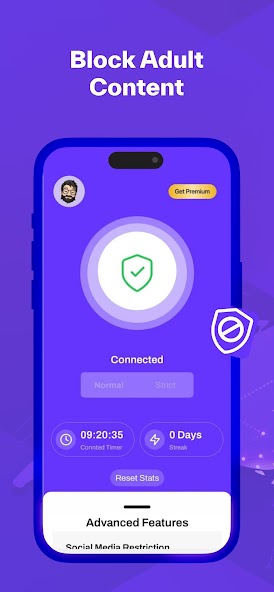
BlockerPlus blocks adult content while respecting your teen's privacy.
🗣️ The 7 Rules for Having This Conversation
No matter your child's age, these principles apply every time you talk to your child about porn or online safety:
1. Pick the Right Moment
Never ambush your kid with "the talk." The best conversations happen side-by-side, not face-to-face. Car rides, walks, cooking together — moments where eye contact is optional and the vibe is casual.
2. Listen More Than You Talk
Ask open-ended questions. "What do you know about…?" is almost always better than "Let me tell you about…"
Your child will tell you what they need if you give them space to talk.
3. Stay Calm — No Matter What They Say
If your child admits they've seen porn, your reaction in the next 5 seconds will determine whether they ever come to you again. Take a breath. Stay neutral. Say "thank you for telling me."
🪞 Recognize yourself? Every parent struggles with this.
The fact that you're reading this article means you're already doing better than most. Keep going.
4. Use Correct Terminology
Don't dance around it. Use the word "pornography." Euphemisms create confusion and signal that this is too shameful to discuss directly.
5. Acknowledge Curiosity as Normal
Curiosity about sex and bodies is developmentally normal. The problem isn't curiosity — it's that the internet delivers hardcore content to a curious child with zero context.
6. Make It Ongoing
One conversation is not enough. Check in regularly. "Have you come across anything online lately that confused you?" normalizes the dialogue over time.
7. Combine Conversation with Action
Bottom line: talking is essential, but it's not enough on its own. Pair your conversations with real protective measures — content filters, monitoring tools, and safe browsing environments.
This is where tools like BlockerPlus become invaluable. It's not about spying on your kids. It's about creating a safer digital environment while you build the trust and communication skills to guide them independently.
💬 Conversations + Protection = Real Safety
Talk to your kids AND protect their devices. BlockerPlus blocks porn, tracks habits, and keeps your child's Android phone clean — without invading their privacy.
Try BlockerPlus Free →❌ What NOT to Say (Common Mistakes)
Knowing what to say is important. Knowing what not to say might be even more critical.
Avoid these phrases:
- ❌ "That's disgusting." → Teaches your child that sexual curiosity is shameful.
- ❌ "You're too young to know about that." → They already know. You're just closing the door.
- ❌ "If I ever catch you looking at that…" → Turns it into a forbidden fruit. Makes them sneakier, not safer.
- ❌ "Only bad kids look at that stuff." → Creates shame spirals. Research shows this increases compulsive behavior.
- ❌ "We'll talk about it when you're older." → The internet won't wait. Neither should you.
Say these instead:
- ✅ "It's totally normal to be curious. Let's talk about healthy ways to understand these things."
- ✅ "Pornography isn't real — it's like a movie. Real relationships don't work that way."
- ✅ "If someone shows you something uncomfortable, that's not your fault."
- ✅ "I'm always here to talk, no matter what. You will never be in trouble for being honest with me."
🔍 Did You Know?
A study published in JAMA Pediatrics found that children who had open conversations with parents about online risks were 40% less likely to engage in risky online behavior — and significantly more likely to report inappropriate content or contact to a trusted adult.
🛡️ Beyond the Talk: Practical Protection Steps
Conversations build trust. Technology builds guardrails. You need both.
Here's what most people don't realize: even the most open, communicative parent can't compete with algorithms designed to serve addictive content. Having the conversation is step one. Backing it up with tools is step two.
Your action plan:
- Install a content blocker. BlockerPlus blocks adult websites and content at the device level on Android. It takes 2 minutes to set up and works across all browsers and apps.
- Set up Safe Search. Enable Google SafeSearch, YouTube Restricted Mode, and equivalent settings on every platform your child uses.
- Keep devices in common areas. No phones or tablets in bedrooms at night — for kids and teens.
- Know what apps they're using. TikTok, Snapchat, Discord, and even Roblox have been vectors for exposure to inappropriate content.
- Create a family media agreement. Write down the rules together. Kids who co-create rules are more likely to follow them.
- Schedule regular check-ins. A monthly "digital life" conversation keeps the dialogue alive without making it feel like a big deal.
💡 Pro Tip
When installing a blocker, involve your child in the process (for ages 10+). Explain why you're doing it: "This isn't about not trusting you. It's about making sure your phone is a safe space — the same way we put a fence around the pool." Transparency builds trust. Sneaky installation breeds resentment.
🔄 What If Your Child Has Already Been Exposed?
If your child has already seen pornography — whether they told you or you discovered it — take a breath. This is not a crisis. It's an opportunity.
Here's your step-by-step response:
- Step 1: Stay calm. Your emotional reaction sets the tone for everything that follows.
- Step 2: Thank them for telling you (if they disclosed it). Reinforce that honesty is always safe with you.
- Step 3: Ask open-ended questions. "How did you feel when you saw it?" "Do you have any questions about what you saw?"
- Step 4: Provide context. Explain that pornography is not reality, and that it doesn't represent healthy relationships.
- Step 5: Take action together. "Let's set up some tools to make sure this doesn't happen again. I use BlockerPlus on my phone too — it's not a punishment, it's protection."
The good news? A single exposure doesn't cause lasting harm when met with a supportive, informed parental response. It's repeated, unaddressed exposure — combined with silence from trusted adults — that creates problems.
1 in 4
children report that their first exposure to pornography was accidental — through a pop-up ad, a mistyped URL, or a link sent by a friend (Internet Watch Foundation, 2024).
📚 Resources for Parents
You don't have to figure this out alone. Here are trusted resources to help you continue the conversation:
- Common Sense Media (commonsensemedia.org) — Age-by-age guides for media and tech conversations.
- Protect Young Minds — Authors of Good Pictures Bad Pictures, a read-aloud book for younger children.
- Culture Reframed — Free online program for parents navigating the porn-saturated world.
- Our blog: Best Free Parental Control Apps for Android (2026)
- Related reading: How to Block Adult Websites on Chrome Android
- Also helpful: Signs of Porn Addiction — How to Know If There's a Problem
💪 You've Got This
Here's the truth: there's no perfect way to talk to your child about porn. You'll stumble over words. It might feel awkward. Your kid might roll their eyes or say "I know, Mom" or "Can we not?"
That's all fine.
What matters is that you showed up. You opened the door. You made it clear that your child can come to you with the hard, confusing, uncomfortable stuff — and you won't freak out.
That single act of courage does more than any single app or filter ever could.
But here's the thing: you don't have to choose between conversation and protection. The best approach uses both.
Talk to your kids. Keep talking. And while you build that trust, let BlockerPlus handle the guardrails.
🛡️ Protect Your Child's Digital World Today
BlockerPlus blocks adult content on Android — silently, effectively, and without invading your child's privacy. Free to download. Takes 2 minutes to set up.
Get BlockerPlus Free on Google Play
Preetam Rangadal
Founder, BlockerPlus · Digital Wellness Expert
Preetam is the founder of BlockerPlus, used by 105,000+ people worldwide to overcome porn addiction. With a background in mobile development and a passion for digital wellness, he builds tools that help people take back control of their lives. Learn more →
Disclaimer: This content is for informational purposes only and does not constitute medical or psychological advice. If you're struggling with addiction, please consult a licensed healthcare professional. BlockerPlus is a digital tool, not a substitute for professional treatment.